
Livingston Parish Criminal Court Records
The Livingston Parish Clerk Criminal and Traffic Department files formal charges from the District Attorney's Office. It handles felony charges for Livingston Parish crimes and handles misdemeanor charges and traffic citations outside municipal court city limits. That means a criminal court record begins with a formal court filing, not merely with an arrest.
The court structure also affects the search. The 21st Judicial District Court is the general trial court for Livingston Parish and serves Livingston, St. Helena, and Tangipahoa Parishes. Denham Springs City Court and Walker Municipal Court handle their own local municipal matters, so some misdemeanors and traffic cases are not district criminal files.
The Clerk criminal department source shows how formal charges and criminal traffic filings enter the court record.
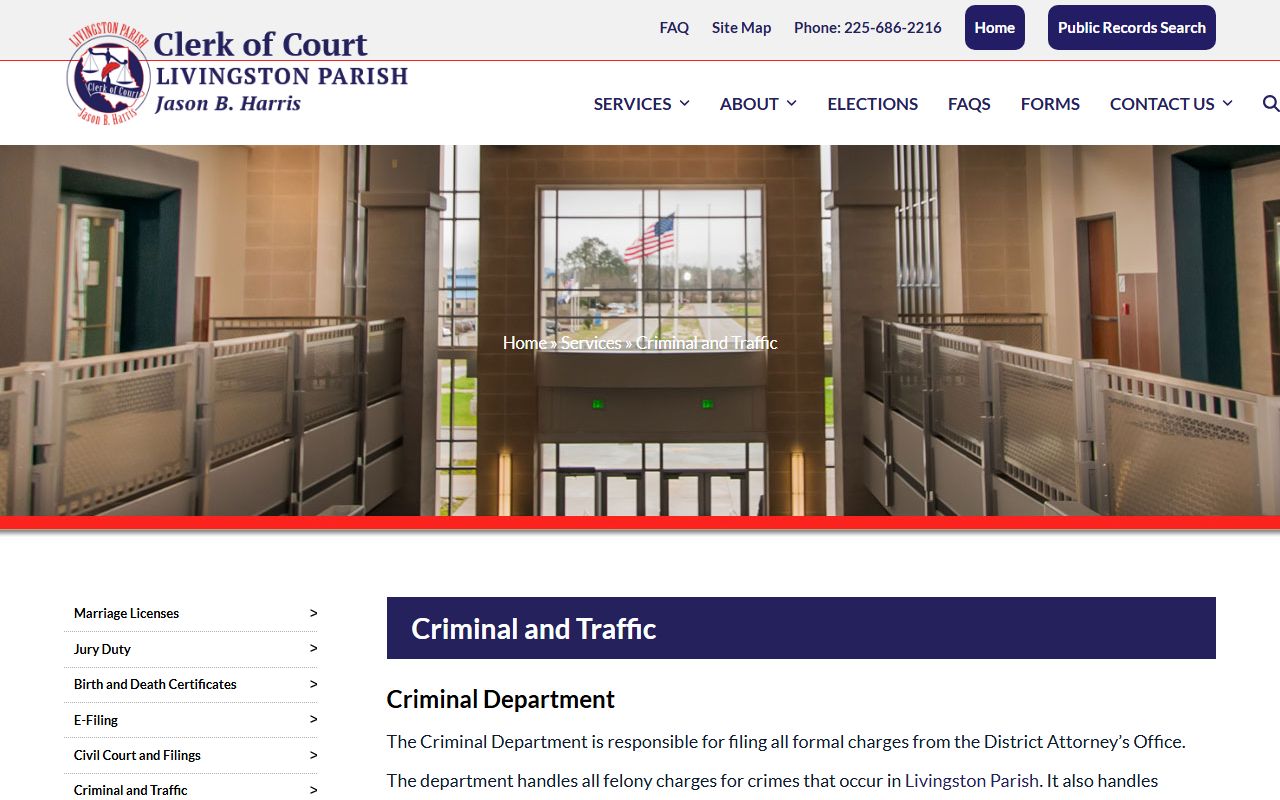
This Clerk department is the key local office for filed criminal charges, dispositions, subpoenas, and bench warrant records.
Search Livingston Parish Criminal Records
Criminal court record searches should start with the Clerk and the 21st JDC, then move to municipal courts if the offense happened inside city limits. The Clerk FAQ says criminal dispositions must be requested in writing and cost $10 per name per charge. The request and check or money order should be mailed to the Clerk at ATTN: Criminal Filing Desk, P.O. Box 1150, Livingston, LA 70754.
Use the written route when the exact final disposition must be proved.
Municipal routing should be checked early. Denham Springs City Court has its own citation payment and warrant check links. Walker Municipal Court handles Walker traffic tickets, misdemeanor charges, Mayor's Court matters, payment questions, and local warrant confirmation. A district criminal search can miss a city-court matter if the charge never belonged to the 21st JDC.
- Identify whether the matter is a felony, district misdemeanor, traffic case, or municipal case.
- Use the Clerk's criminal department or Clerk eSearch routes where the case type is available.
- Use the defendant name, docket number, division, charge, arrest date, or citation number if known.
- Read the docket for arraignment, motions, plea, disposition, sentencing, or bench warrant entries.
- Request a written criminal disposition from the Clerk when an official outcome is needed.
The Clerk forms page contains expungement and criminal record check materials relevant to criminal case records.

Forms can start a request or expungement process, but Clerk staff cannot complete forms or give legal advice.
Criminal Case Flow
A Livingston Parish criminal court record can change at each stage. The jail roster may show the first arrest charge. The District Attorney may later file a bill of information or other charging document, amend charges, refuse a charge, dismiss a count, or proceed to plea or trial. The court record should be read by charge and by date because one defendant can have multiple counts with different outcomes.
Minute entries are especially useful in this flow. Minute clerks keep and transcribe court minutes, maintain criminal and civil dockets, send judgment notices, prepare appeals, and process attachments. Those entries can explain why the same case has a hearing date, bench warrant, continuance, plea setting, and disposition listed at different points.
Case flow: Charges Filed › Arraignment › Pretrial and Motions › Plea or Trial › Disposition › Sentencing
| Stage | What Happens |
|---|---|
| Charges filed | The DA's formal charge creates the court case record through the Clerk. |
| Arraignment | The defendant is called into court and a plea step may be recorded. |
| Pretrial and motions | The docket may show subpoenas, motions, continuances, hearings, or warrants. |
| Plea or trial | The case moves toward a negotiated plea, bench trial, jury trial, or other outcome. |
| Disposition | Each charge receives an outcome such as guilty plea, dismissal, acquittal, or other result. |
| Sentencing | The record may show jail, probation, restitution, costs, fines, or court program terms. |
What Criminal Records Show
Livingston Parish criminal court records can include structured fields and narrative entries. The research file identifies case and docket number fields, division, court, State of Louisiana versus defendant party style, charge or statute, arresting agency, DA formal filing, subpoena and bench warrant data, disposition, sentence, probation, restitution, and costs. Some identifiers are not public in ordinary online views.
| Field | What It Shows |
|---|---|
| Case or docket number | The official criminal file number. |
| Division | The assigned 21st JDC division when shown. |
| Defendant | The person charged in State of Louisiana versus defendant format. |
| Charges | Filed statute, offense name, count, and current charge status. |
| Arraignment and plea | Initial plea and later plea changes when recorded. |
| Disposition | The outcome for each charge. |
| Sentence | Custody, probation, restitution, costs, fines, or court program terms. |
| Warrants and subpoenas | Bench warrants, criminal subpoenas, or attachments tied to the case. |
Charges vs Convictions
A filed charge is an accusation in court. A conviction is a final result by guilty plea, verdict, or other qualifying court outcome. Livingston Parish criminal court records can show charges that were amended, refused, dismissed, reduced, or resolved differently from the arrest booking entry. For a close look at arrest-side charges, use the arrest records and court charges page.
| Point | Charge | Conviction |
|---|---|---|
| Meaning | Formal accusation filed or listed in the case | Final guilt outcome by plea or verdict |
| Can change? | Yes, it may be amended, reduced, dismissed, or refused | Can be affected by appeal, post-conviction relief, or expungement access rules |
| Where found | Booking record, DA filing, docket, and case file | Disposition, minute entry, sentence, and certified court copy |
Sealed and Expunged Records
Louisiana expungement is a public-access limit, not simple destruction. The Livingston Parish expungement packet cites Louisiana Code of Criminal Procedure arts. 971-997 and states that Clerk staff cannot assist with completing forms or give legal advice. The packet lists separate money orders for the Clerk, Sheriff, District Attorney, and Louisiana Bureau of Criminal Identification, with additional OMV money orders for DWI conviction expungements.
| Point | Sealed | Expunged |
|---|---|---|
| Public view | Restricted by court order or law | Removed from public access if granted |
| Agency access | May remain available to authorized agencies | May remain available to prosecutors, law enforcement, or judges under statute or order |
| Livingston source | Court order or restricted case file | Clerk expungement packet and court order |
The Louisiana State Police expungement source explains the state processing role after a court order.
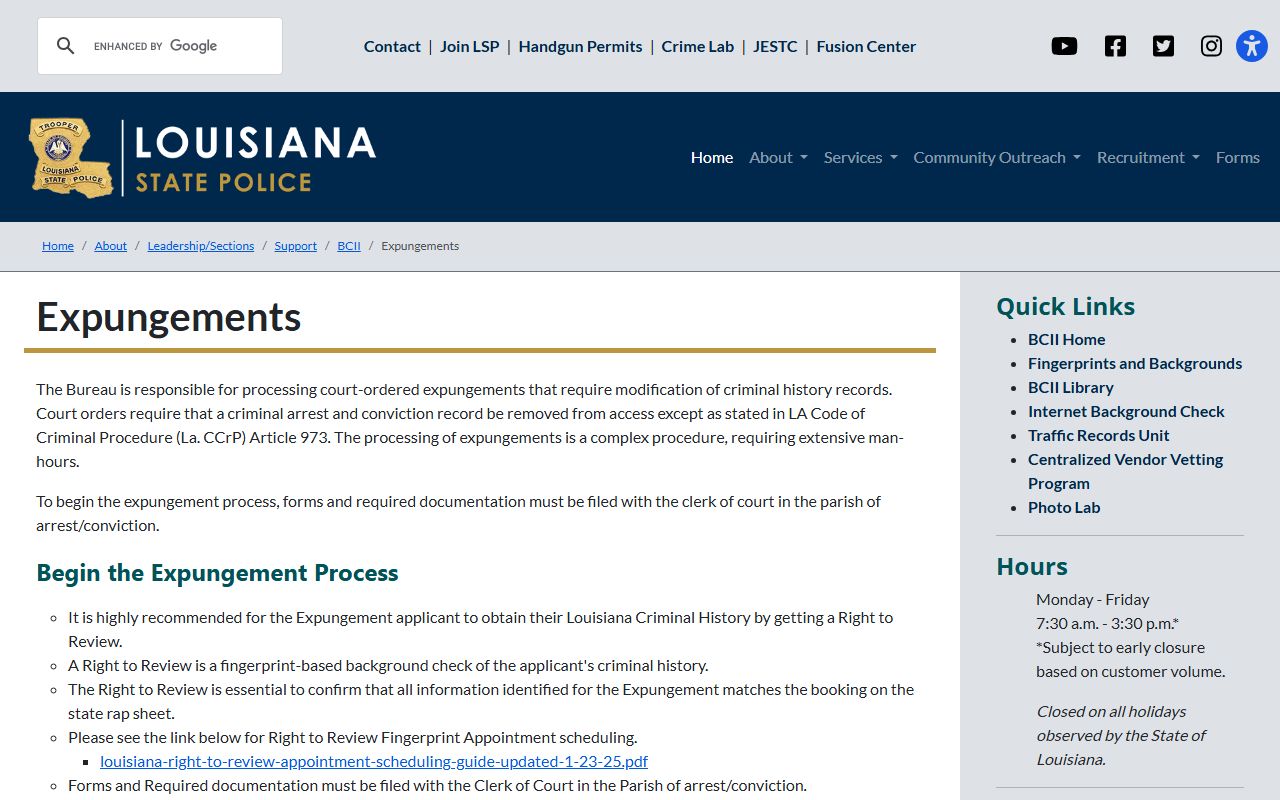
State Police processing is part of the expungement route after a court order is issued.
Public Access and Limits
Louisiana R.S. 44:1 defines public records broadly, but Louisiana Children's Code art. 412 makes juvenile court records and reports confidential except as authorized. Louisiana R.S. 44:3 also limits prosecutive, investigative, and law-enforcement records. A public criminal court file may be open while juvenile, sealed, expunged, sensitive identifier, and active investigation material remains unavailable.
Specialty courts can also affect criminal court records. The 21st JDC Adult Drug Court is tied to Louisiana R.S. 13:5301 and can create docket events, court costs, testing, treatment, and probation conditions. Veterans Treatment Court is a voluntary court-supervised program for eligible veterans with qualifying criminal cases or transferred probation in the district. Juvenile Drug Court is separate and confidential where juvenile records are involved.
The State Public Defender District 21 source is relevant because defense access and representation affect criminal case processing.

Representation details do not replace the court record, but they help users understand the criminal case process.
Note: A jail roster entry is not a certified criminal disposition.